



There are places where history does not live in books alone, and Cape Monumenti, set on the northern side of the Bay of Pula, is one of those magical places. This unique peninsula carries the traces of almost three thousand years of human creativity, military strategy and cultural exchange.
From the very beginning, its fate has been inseparably tied to the development of Pula. From the prehistoric hillforts of the Illyrian tribes, through the opulent Roman Pola and the mighty Austro-Hungarian naval port, all the way to the present day and its complete restoration, Cape Monumenti has witnessed the passing of empires, armies and civilisations. Today, transformed into a sophisticated heritage hotel, Cape Monumenti brings together the rich legacy of the past and the finest luxury of modern tourism, offering guests the chance to experience the history of Pula in the most beautiful way imaginable.
The oldest roots: the Histri and prehistory
The story of Pula and Cape Monumenti does not begin with the arrival of the great empires, but in more modest yet exceptionally important times — the Bronze and Iron Ages. The first known inhabitants of this region were the Histri, a warlike and skilful Illyrian tribe that gave the entire Istrian peninsula its name.
The Histri were known as outstanding seafarers and herders, but also as fearless warriors who successfully resisted outside influence for centuries. Their social organisation was built around fortified settlements positioned on strategically important elevations — hillforts. From these strongholds, set on high ground with open views over sea and land, the Histri controlled trade routes and protected their communities.
The wider area of Pula and its naturally sheltered bay was an ideal place to live in prehistory. Cape Monumenti, with its natural projection into the sea and its direct view of the gates of Pula and the Brijuni archipelago, offered perfect natural protection. Life before the arrival of the Romans was closely bound to nature, fishing and trade with other Mediterranean peoples, including the ancient Greeks. Tradition and archaeological finds suggest that this very coastline was a key point of contact between the Histri and the seafarers who sailed the Adriatic, laying the foundations for the urbanisation that would follow.
Roman Pola: the golden age of antiquity
With the fall of the Illyrian kingdom under Roman rule in the 2nd century BC, Istria entered its golden age. The exceptional strategic and geographical importance of the Bay of Pula did not escape the Romans. They founded Colonia Iulia Pollentia Herculia, today’s Pula, which soon grew into a powerful trading, military and administrative centre of the region.
Roman architecture left an indelible mark on the face of the city, and the most famous monument of that era is undoubtedly the Pula Arena. This magnificent amphitheatre, built in the 1st century during the reign of the Flavian emperors, rivalled the one in Rome and could hold more than 20,000 spectators. It hosted gladiator fights and public performances, and today it stands as one of the best-preserved Roman amphitheatres in the world.
Beyond the Arena, Roman Pola acquired its distinctive forum, the centre of public and religious life, where the Temple of Augustus still stands proudly today. Built between 2 BC and AD 14, this temple dedicated to the Emperor Augustus and the goddess Roma is a supreme example of classical Roman architecture. Nearby stands the Arch of the Sergii, also known as the Golden Gate, raised in honour of the Sergii family who held high office in the city.
In that ancient period, the natural resources of Cape Monumenti and the surrounding coves were used for quarries, agricultural estates (villae rusticae) and anchorages. Pula fitted perfectly into the wider network of the Roman Empire, connecting the overland routes to the north with the maritime routes leading towards the seats of the Empire.
The Venetian and Habsburg periods
After the fall of the Roman Empire, Pula passed through turbulent centuries of changing rulers, epidemics and wars. During the centuries of Venetian administration (from the 14th to the end of the 18th century), the city became an important Venetian stronghold, but Pula’s true and most dramatic modern turning point came in the middle of the 19th century under the rule of the Habsburg Monarchy.
By decree of Emperor Franz Joseph I in 1853, Pula was proclaimed the main naval port of the Austro-Hungarian Monarchy. This decision fundamentally changed the fate of a small town that at the time had only a few thousand inhabitants. In just a few decades, Pula was transformed into a modern European metropolis, an unrivalled military stronghold and an industrial centre. The Uljanik shipyard, the arsenal, transport infrastructure and an imposing defensive system were built, the latter consisting of dozens of forts, batteries and barracks closely arranged around the city and the bay.
The military architecture of that period had a direct impact on Cape Monumenti. The western coast of Pula, with its peninsulas and islands, became a key line of defence from which the entire port of Pula and the approaches from the open sea were monitored. Numerous stone forts, underground tunnels and military structures were built to the highest construction standards of the time, and the combination of Istrian stone and precise Austro-Hungarian engineering still inspires admiration today.
The story of Cape Monumenti
It is precisely within the context of the Austro-Hungarian period and its military history that the distinctive identity of Cape Monumenti was shaped. The name “Monumenti” carries a certain air of mystery and reverence. It comes from the Italian word for monuments, and it is believed that the name arose from the impressive architectural and military defensive structures and the archaeological finds that have adorned this location over the centuries.
The position of Cape Monumenti is exceptionally appealing: set directly opposite the very core of Pula, it offers an incomparable view on one side towards the port of Pula and the old town, and on the other towards the open sea and the enchanting Brijuni archipelago. Because of this key position, the cape was for decades a military zone closed to the public, which paradoxically helped preserve its nature and historic buildings in their original form, far from mass urbanisation.

Complex military facilities were built at this location, serving to house troops, store supplies and defend the harbour. However, as geopolitical circumstances changed in the 20th century, these buildings gradually lost their original purpose.
The transformation began with a vision of preserving this valuable architectural heritage. Instead of being left to the ravages of time, the historic buildings from the Austro-Hungarian era were meticulously and carefully restored. Today this space has been turned into the exclusive, protected heritage hotel Monumenti, which has succeeded in reconciling strict conservation requirements with modern standards of hospitality. Every stone, passage and high ceiling tells a story of proclamations, officers and romantic times gone by.
Pula and Cape Monumenti today
Today, Cape Monumenti is the link between the rich history of Pula and a contemporary tourism offer. A stay on the cape is a rare opportunity to slow down and immerse yourself in the authentic atmosphere of Istria.
For all visitors staying at Hotel Monumenti, the location is an ideal starting point for exploring everything Pula and its surroundings have to offer:
-
Exploring the historic centre of Pula: Just a few minutes from the hotel lies the old town centre with the Roman monuments mentioned above — the Arena, the Temple of Augustus, the Twin Gates and the Kaštel, a Venetian fortress offering a panoramic view over the entire city.
-
Brijuni National Park: Islands regarded throughout history as a paradise on earth lie in the immediate vicinity. They are easily reached from nearby Fažana and offer a blend of untouched nature, a safari park and archaeological sites from the Roman and Byzantine periods.
-
Cultural events and gastronomy: Pula is today a vibrant city known for its film festival in the Arena and concerts by world-renowned musicians, as well as for outstanding Istrian gastronomy, from fresh seafood to Istrian truffles and superb olive oils.

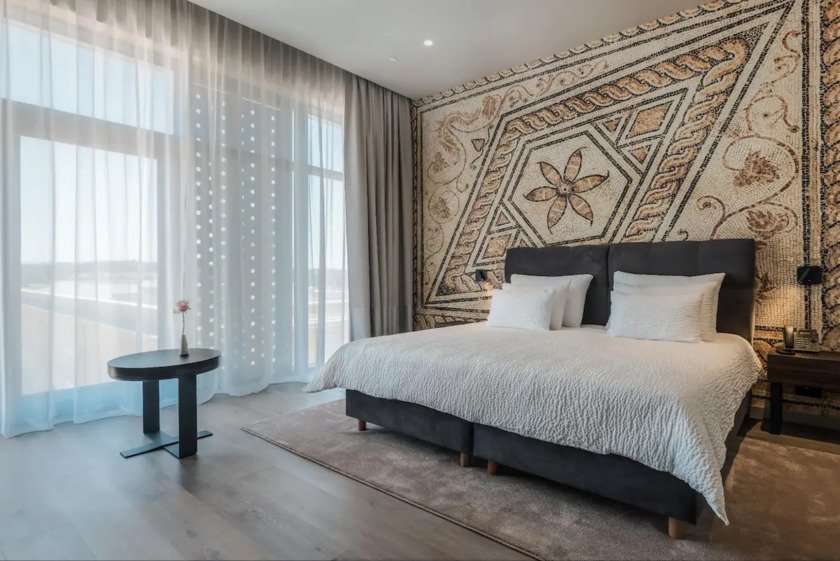
How do you experience the history of Pula by staying in heritage rooms? The answer lies in the stay itself, as offered by Hotel Monumenti. Walking through the corridors of this carefully restored building means stepping into the past without giving up contemporary luxury. Sleeping in spacious rooms and suites whose walls are made of authentic Istrian stone, with high ceilings, warm wooden tones and a carefully chosen design that unites Austro-Hungarian elegance with modern comfort, creates the feeling of a genuine journey through time. Every detail of the interior has been conceived with respect for the architectural heritage, creating a welcoming, warm and refined ambience in which the historical narrative naturally intertwines with exceptional comfort.
From the windows of your elegant suite or room, a fascinating and uninterrupted view opens onto the open sea, the Bay of Pula and the ships entering the harbour — the very same impressive scene once observed from this strategic point by Austro-Hungarian commanders and sailors. In the morning you are woken here by the sound of the sea and the gentle scent of pines, while the evenings invite you to relax on private terraces with a spectacular sunset over the Brijuni archipelago.
Hotel Monumenti is not merely a place to spend the night, but the centre of an experience in which history is actively lived. Whether you are enjoying your morning coffee on a sunlit terrace, unwinding in the superb wellness oasis or tasting traditional Istrian specialities prepared in a modern way in the hotel restaurant, you will feel the special energy of this historic location. Cape Monumenti and the city of Pula are not just another destination on the tourist map. They are a living monument to a place, a time and the people who created it. To stay at Hotel Monumenti is to become an inseparable part of a story that has already lasted three thousand years, creating your own memories in a place where centuries-old tradition meets timeless Mediterranean luxury.
